



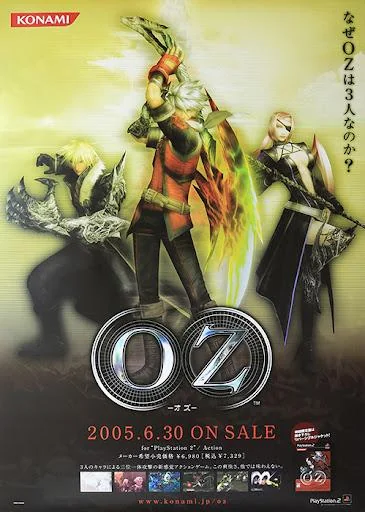
It’s 2005, you’re young and on your way to your favourite game-store. That hard saved pocket-money you spend today will determine what type of adventure you’ll be experiencing on your Playstation 2 for the next month, if not more.
There’s God of War, only a few months old and still full-price, so is Tom Clancy’s Splinter Cell: Chaos Theory. Between the big expensive names you suddenly spot something different, and already on sale. Its name, OZ, is a reference to something you remember from your childhood, The Wizard of OZ. And then you pause…”is that the Konami logo”? You feel like you just found a hidden treasure, pay up, run home, pop in the disc and… your journey begins.
OZ stands for Over Zenith, but in other regions it was called Chains of Power (Korea) and The Sword of Etheria (Europe). The only exception being The United States, where it never got published. To avoid confusion we’ll stick to its original title Over Zenith for the rest of the article.
Helmed by Konami’s Junichi Murakami, who had worked his way up from graphic designer on games such as Animaniacs to directing Castlevania: Aria of Sorrow, Over Zenith tells the tale of a young boy named Feel trying to rescue his sister Dorothy in a world of powerful gods and rampant monsters.
Frank L. Baum’s The Wizard of Oz book license, having become part of the public domain like Dracula before it had for Castlevania, opened numerous doors. The final product however mostly uses it for cheeky references here and there, rather than being the core of the story, as Feel and his compatriots travel across the world to save his sister.
After a short introductory sequence, the game opens up with a combat-system featuring the usual block, dodge, perfect parry options, as well as the typical attack-string and jump. You lock-on, fight the big monster and listen to some great music by Castlevanias’s own Michiru Yamane. Nothing too special, nothing too bad either. It’s not until the second stage that your first ally joins your party and the game starts to take on its own, unique shape.
Juggling is a core aspect of many action-games, allowing players to temporarily combo an enemy freely for safe damage or for a form of combat-expression. In Over Zenith juggling instead revolves around bouncing enemies between Feel and his party-members.
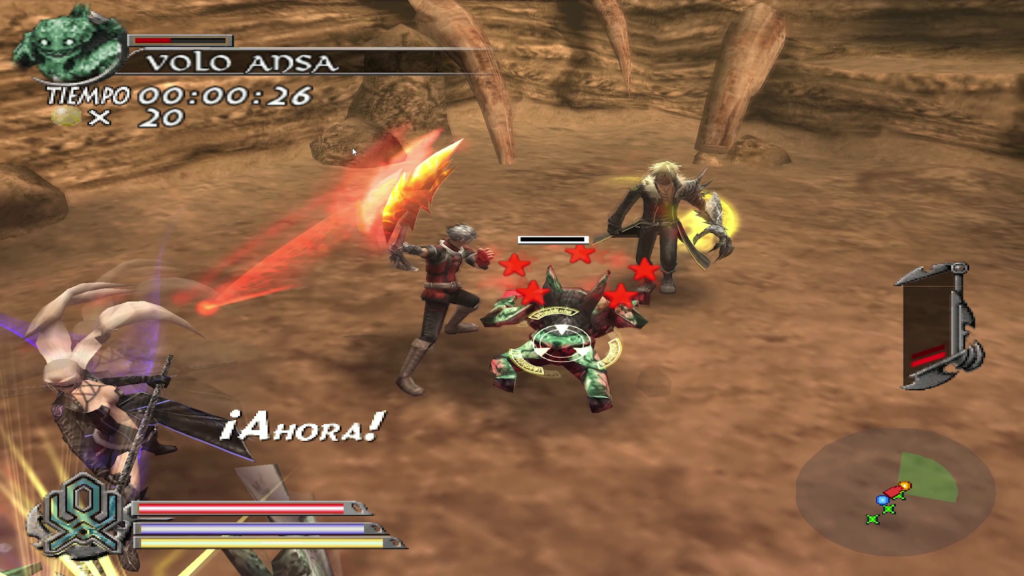
Hit an enemy enough and they’ll be stunned, allowing you to launch them towards an ally, who will then knock them to the other ally and then back to you. Keep the juggle going and a Tension Meter will fill up, drop the chain and it plummets. When filled Tension can be spent for a selection of invincible super attacks, which range from a simple level-1 slash to a lengthy level-4 screenclearing cinematic.
It doesn’t take long for the combat to revolve around you juggling weaker enemies to set up stronger attacks on the bigger threats, while ranged enemies try to pressure you into dropping your combo. Missions offer some slopes and hills to make juggles a bit more interesting, while also at times adding other hazards like water that makes movement slower or even maneating-walls that you can juggle enemies into. And while you cannot juggle multiple enemies in one giant ball of doom, you can juggle multiple in a row to keep a stronger chain going and build your Tension faster.
You’ll want to keep using your Tension, as enemies killed with it offer up more cash, which can be used to buy RPG-esque upgrades like rings for buffs like increased Tension-buildup or imbuing your weapon with Lightning, or to buy upgrades for more health and damage. These are all minor upgrades though, and it’s the main combat that stays at the center, with little distractions outside of an occasional branching path.
Luckily fights escalate quickly, introducing tougher, more resilient enemies alongside spawners that demand constant pressure. Bosses frequently summon additional enemies as well, but not just to overwhelm you, but also to give you targets to juggle and build Tension. Shielded enemies add another layer, forcing you to direct your party with the O-button to pressure their guard to create openings for you to flank them.
Juggling multiple enemies in a chain and finishing it in a well-positioned and timed explosion is a great feeling. On the flip side it also can lead to situations where you desperately try to stagger an enemy in a big wave of mooks, constantly running back and forth, only for your CPU ally to stand still and not hit the ‘ball’ back when a juggle finally does happen, making the combat immediately fall flat and frustrating.
This isn’t helped by Feel’s moveset with many of his attacks being slow and with a lot of recovery. If your timing is off by even a few frames you’ll miss the juggle, while many of his other attacks cannot be canceled out of either. It’s a strange choice in a game about quick juggles to make the combat so deliberate, while also giving his attacks so much recovery that if your allies are closeby, and you juggle into them, you’ll still be in your recovery as they bounce the enemy back to you.
This problem is somewhat elevated on NewGamePlus where you can change party members, including the one you control. While most characters are a case of ‘different animations, same effect’ compared to Feel, there are some like JuJu who are much faster in their recovery, one of the reasons she is a top pick for achieving higher scores.

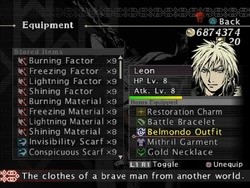
And you will need to use your characters smartly and plan out your combos if you wish to clear the game with an S-rank. Because in a fun twist, getting a higher rank also changes the ending of the game, incentivizing replays and mastery. When going for S-rank you’ll start playing around with what gearpieces you have and what party members to bring for their own unique super attacks regarding the stage. Perhaps you want Leon for his wallbounce Super, or Vitis for his giant deathball Super which is great against the tightly packed enemies of Chapter 18. Paired with the more open ended stages requiring replanned routing, a strict timer and score-requirement, and you’ve got something to really sink your teeth into, making you see a bit more of the game’s depth.
That said, this challenge, and all the bonus costumes, optional endings and different unlockable characters, don’t show their face until you’ve beaten the game once, not to mention other bonus modes such as a Super Sentai gamemode. And even then it still results in you doing the same thing and facing the same problem: you’re juggling an enemy to an NPC ally that you have little control over, and not much else.
By Chapter 4 you’ve generally seen the entire combatflow of the game, which goes on for 20 Chapters in total, with the same lengthy super-moves and same juggle setups on the same 5 or 6 enemy-types in long stages rife with reused assets. As a result, Over Zenith seems best played in bursts, to avoid repetition sinking in.
As a whole the ‘volleyball combat’ is an interesting idea, but barely halfway through you’ll already feel that it needs a bit more variation in the combat engine and specials. If meter gave more advantages besides dumping it constantly for Supers or if the game speed was upped ever so slightly, while either giving you more control over your allies, or having them juggle more consistently, the game would already be vastly improved.
Other elements also could’ve been expanded upon. For example there’s one enemy type that shoots cannonballs that you can hit back at them, as a mini-juggle, which is a great idea that’s never seen again. One could also consider how juggling enemies into walls would’ve worked, or given some Supers more utility like status effects, timeslows or other creative solutions. Or perhaps allow players to swap control to other characters mid-combat for more planning and setups. Over Zenith offers an interesting concept, but seems afraid of expanding upon it.
That’s not to say more options would equal higher quality by default. As discussed in the past, some titles like Shinobi thrive on its outward simplicity, which is lost when needless complexity is added as we saw in its sequel. Yet in Over Zenith the base mechanics don’t offer much in terms of complexity by default, nor in its enemy design or the way encounters are structured. As it stands, even a speed increase would already make the game flow much better, though bigger additions would see it grow even more and give its core concept of bouncing enemies between your allies something extra.
Currently, at its best moment you’re juggling, doing cool Supers to a fantastic soundtrack and reflecting projectiles mid-combo. At the worst, you’re starting a juggle that goes unanswered, followed by you getting hit by offscreen attacks during your massive recovery only to watch your allies die and your Tension drops as you whittle away for chip damage for minutes on end waiting for your allies to recover… only for them to run to their death immediately again. You could be pumping your fist one minute, and raging the next, making for a very inconsistent experience.
As a result, had you picked this up back in the day, its content could’ve kept you busy for weeks on end. In today’s market however, with so many strong legacy titles to experience, Over Zenith cannot help but feel undercooked. Still, if you approach it in bursts, enjoy chasing and planning for higher ranks, and don’t mind the heavy reuse of animations and environments, its unique combat will definitely keep you engaged.
鑒 reflection style 鑒
In this short section I reflect on the article from my own viewpoints as a gamer and lover of the genre instead of a critic.
Over Zenith is such a two-faced title for me. I was entranced by its beautiful soundtrack for months, listening to it way past my completion of it and having dug deep into New Game Plus. But it’s also a title that made me consider throwing my controller into my CRT. I cannot overstate how great it feels to set up a kill combo, and how frustrating it is when your ally just stands there idle as you juggle into them to no reply.
Some bosses, like Ultores from Chapter 16, drove me up the wall with their combination of slowing water, multiple juggles required to even be allowed to damage him as well as the brain-dead AI refusing to cooperate as a giant laser stunlocked them to death as I yelled “come over here” over and over in a bout of game-induced insanity.
I know there’s people that swear by this game as one of the action-genre’s true hidden gems, and I can see the appeal as noted in the article. Setting up juggles for Super moves, strategizing for S-ranks, there’s a lot of little details you can experiment with that all pay off. Yet I cannot help but consider how much better the game would be with minor changes, and how having your combat revolve around the whims of your AI-helpers is just something that goes wrong more often than not.
As such I do recommend checking out the title to form your own opinion, but I’d be lying if I said I wasn’t counting the hours near the end, and only dove into NG+ for the sake of this article. As it stands I doubt I’ll ever touch this game again.